Thursday, September 18, 2014

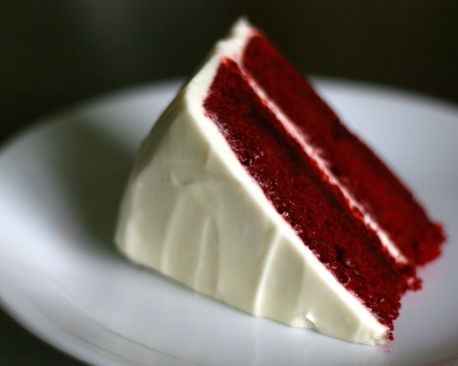
RED VELVET CAKE Recipe


RED VELVET CAKE 


Dear, friends today I am going to share about some delicious recipe that will make your mouth go watery. Your order cake for some special occasion but you can bake it at home also yourself. Today I am going to share recipe about my one of my favorite cake “Red Velvet Cake”. A Red Velvet Cake is very dramatic looking with its bright red color that is offset by a creamy white frosting. Let’s start from our ingredients.

INGREDIENTS
*      2 1/2 cups (250 grams) sifted cake flour
*      1/2 teaspoon salt
*      2 tablespoons (15 grams) regular or Dutch-processed cocoa powder
*      1/2 cup (113 grams) unsalted butter, at room temperature
*      1 1/2 cups (300 grams) granulated white sugar
*      2 large eggs
*      1 teaspoon pure vanilla extract
*      1 cup (240 ml) buttermilk
*      2 tablespoons liquid red food coloring
*      1 teaspoon white distilled vinegar
*       1 teaspoon baking soda

Cream Cheese Frosting:
*      1-- 8 ounce (227 grams) cream cheese, room temperature
*      1 - 8 ounce (227 grams) tub of Mascarpone cheese, room temperature
*      1 teaspoon pure vanilla extract
*      1 cup (115 grams) confectioners' (icing or powdered) sugar, sifted
*      1 1/2 (360 ml) cups cold heavy whipping cream (double cream) (35-40% butterfat)

Preheat oven to 350 degrees F (175 degrees C) and place rack in center of oven. Butter two - 9 inch (23 cm) round cake pans and line the bottoms of the pans with parchment paper. Set aside.
In a mixing bowl sift together the flour, salt, and cocoa powder. Set aside.


In bowl of your electric mixer, or with a hand mixer, beat the butter until soft (about 1-2 minutes). Add the sugar and beat until light and fluffy (about 2-3 minutes). Add the eggs, one at a time, beating well after each addition. Scrape down the sides of the bowl. Add the vanilla extract and beat until combined.
In a measuring cup whisk the buttermilk with the red food coloring. With the mixer on low speed, alternately add the flour mixture and buttermilk to the butter mixture, in three additions, beginning and ending with the flour.
In a small cup combine the vinegar and baking soda. Allow the mixture to fizz and then quickly fold into the cake batter. 


Working quickly, divides the batter evenly between the two prepared pans and smooths the tops with an offset spatula or the back of a spoon. Bake in the preheated oven for approximately 25 - 30 minutes, or until a toothpick inserted in the center of the cakes comes out clean. Cool the cakes in their pans on a wire rack for 10 minutes. Place a wire rack on top of the cake pan and invert, lifting off the pan. Once the cakes have completely cooled, wrap in plastic and place the cake layers in the refrigerator for at least an hour (or overnight). (This is done to make filling and frosting the cakes easier.)


Cream Cheese Frosting: In the bowl of your electric mixer, or with a hand mixer, beat the cream cheese and mascarpone cheese until smooth. Add the vanilla and confectioners’ sugar and beat until smooth. Using the whisk attachment, gradually add the heavy cream and whip until the frosting is thick enough to spread. Add more sugar or cream as needed to get the right consistency.


Assemble: With a serrated knife, cut each cake layer in half, horizontally. You will now have four cake layers. Place one of the cake layers, top of the cake facing down, onto your serving platter. Spread the cake layer with a layer of frosting.  Place another layer of cake on top of the frosting and continue to frost and stack the cake layers. Frost the top and sides of the cake. Can garnish the cake with sweetened or unsweetened coconut.


Serves 10 - 12 people.
Note: You must use a brand of heavy cream that whips very easily to stiff peaks. If you are using a brand of heavy cream that does not whip easily to stiff peaks then whip the heavy cream separately to stiff peaks and then fold it into the cream cheese mixture.


Wednesday, September 17, 2014

pr

Many women begin using anti-aging products once they turn thirty, while some start as soon as their mid-twenties. Whenever you choose to achieve this, you need to look for a product that fits your skin care needs. To achieve that, you have to find out about a product's elements as well as their effects in your skin. Continue reading and do not forget to visit our website for the best facial cleansing brush on the web.
Here are a few popular natural elements utilized on anti-aging products:
Grape Stem Cell
Using its anti-inflammatory qualities, Grape Stem Cells fight the dreadful indications of aging effectively. In addition, they eliminate toxins, which damage the dwelling of skin cells. Grape Stem Cells also safeguard the skin in the dangerous results of Ultra violet sun rays, a significant reason for skin aging. Research has shown these plant stem cells, when coupled with other anti-aging qualities, can boost the regrowth efficiency of skin cells.
Fruit Chemicals
Fruit chemicals, particularly Alpha-Hydroxy Chemicals (AHA), keep your skin's youthful glow. Additionally they balance out the skin tone, keep the skin firm, and lower acne along with other blemishes. In addition, fruit chemicals are popular exfoliants. These naturally sourced elements reduce skin cell cohesion and permit cell renewal to happen more freely.
Many anti-aging products use fruit chemicals in their elements, as they possibly can decrease the appearance old spots and lighten scars. Additionally they stimulate elastin and bovine collagen production, which stop your skin from sagging and getting facial lines.
Ginkgo Biloba
Ginkgo Biloba does not only enhance bloodstream flow and memory, it safeguards the general health of skin cells, too. Using its potent anti-oxidant qualities, it may protect against toxins easily. In addition, the anti-inflammatory qualities of Ginkgo Biloba can help to eliminate the appearance of certain skin conditions, for example eczema and rosacea.
Peptides
Bovine collagen-like peptides have deep and intense effects on facial lines. Based on the National Center for Biotechnology Information, they are able to stimulate general cell metabolic process, which cuts down on the total the surface of facial lines. Research also implies that bovine collagen-like peptides work well in lowering the typical and total length and depth of facial lines.
Retinol
Retinol is really a Vit A derivative that improves bovine collagen production as well as out skin discoloration. Additionally, it increases producing new skin cells, which will keep you searching youthful and fresh. Retinol also reduces outbreaks, because it prevents harmful particles and dead skin cells from obstructing the pores. For the best facial treatment, visit our website for more information and awesome beauty products.

walnut benifits

Photo: Walnuts are one of the most antioxidant rich foods and are an excellent source of omega-3 fatty acids which have anti-inflammatory properties and are known to help prevent strokes, diabetes, coronary artery disease, and colon, prostate, and breast cancers. Walnuts are also high in B-complex vitamins and minerals such as copper, iron, manganese, zinc, calcium, and selenium. Walnuts are particularly beneficial for cognitive health and are generally regarded as an excellent “brain food”. Walnuts can also calm the nervous system and increase your sense of well being and peace. They are known to satiate the appetite as well as aid in long term weight loss. Walnuts are high in vitamin E which helps to keeps cells protected from free radical damage. Walnuts are also very important for the neurological and circulatory systems and can help to benefit neuropathy, cerebral palsy, dementia, raynaud’s disease, and atherosclerosis. Walnut oil is a wonderful moisturizer for the skin and is regularly used in skin care products for its healing and protective benefits. Try mashing a few ripe bananas and sprinkling chopped walnuts on top for a energy and brain boosting breakfast. Only a handful of walnuts a day are needed to receive their powerful health benefits.


    WALNUT


 Walnuts are part of the tree nut family. This food family includes Brazil nuts, cashews, hazelnuts (filberts), macadamia nuts, pecans, pine nuts, pistachios and walnuts. It would be difficult to overestimate the potential health benefits associated with this food family! In the majority of dietary studies, approximately one ounce of tree nuts per day is the minimal amount needed to provide statistically significant benefits, and that's the amount we recommend that you incorporate into your daily diet. In the case of walnuts, one ounce means about 7 shelled walnuts, or 14 walnut halves. Of course, since tree nuts (including walnuts) are a high-calorie food, it's important to incorporate tree nuts into an overall healthy diet that remains on target in terms of calories. Luckily, research has shown that many people are able to take this step with good success in terms of overall caloric intake.


which have anti-inflammatory properties and are known to help prevent strokes, diabetes, coronary artery disease, and colon, prostate, and breast cancers. Walnuts are also high in B-complex vitamins and minerals such as copper, iron, manganese, zinc, calcium, and selenium.


Walnuts are rich source of energy and contain health benefiting nutrients, minerals, antioxidants and vitamins that are essential for optimum health. Eating as just as 25 g of walnuts per day provides about 90% of RDI (recommended daily intake) of omega-3 fatty acids. Research studies have suggested that n-3 fatty acids by their virtue of anti-inflammatory action help lower blood pressure, cut down coronary artery disease, and stroke risk, and offer protection from breast, colon and prostate cancers.


Although we think about type 2 diabetes as a problem primarily related to blood sugar control and insulin metabolism, persons diagnosed with type 2 diabetes typically have health problems in other related systems, and are at special risk for cardiovascular problems. An important part of the goal in designing a diet plan for persons with type 2 diabetes is lowering the risk of future cardiovascular problems. In this context, consumption of walnuts is establishing a more and more impressive research track record. Increased flexibility in the response of the cardiovascular system following meals has been a repeated finding in research on walnuts. A variety of different measurements on blood vessel functioning (including their measurement by ultrasound) show a relatively small amount of daily walnut intake (1-2 ounces) to provide significant benefits in this area for persons with type 2 diabetes.


Walnuts are particularly beneficial for cognitive health and are generally regarded as an excellent “brain food”. Walnuts can also calm the nervous system and increase your sense of well being and peace. They are known to satiate the appetite as well as aid in long term weight loss.  Additionally, they are rich source of many phyto-chemical substances that may contribute to their overall anti-oxidant activity, including melatonin, ellagic acid, vitamin E, carotenoids, and poly-phenolic compounds. These compounds known to have potential health effects against cancer, aging, inflammation, and neurological diseases.


Walnuts are also very important for the neurological and circulatory systems and can help to benefit neuropathy, cerebral palsy, dementia, raynaud’s  disease, and atherosclerosis. Walnut oil is a wonderful moisturizer for the skin and is regularly used in skin care products for its healing and protective benefits. Try mashing a few ripe bananas and sprinkling chopped walnuts on top for a energy and brain boosting breakfast. Only a handful of walnuts a day are needed to receive their powerful health benefits.